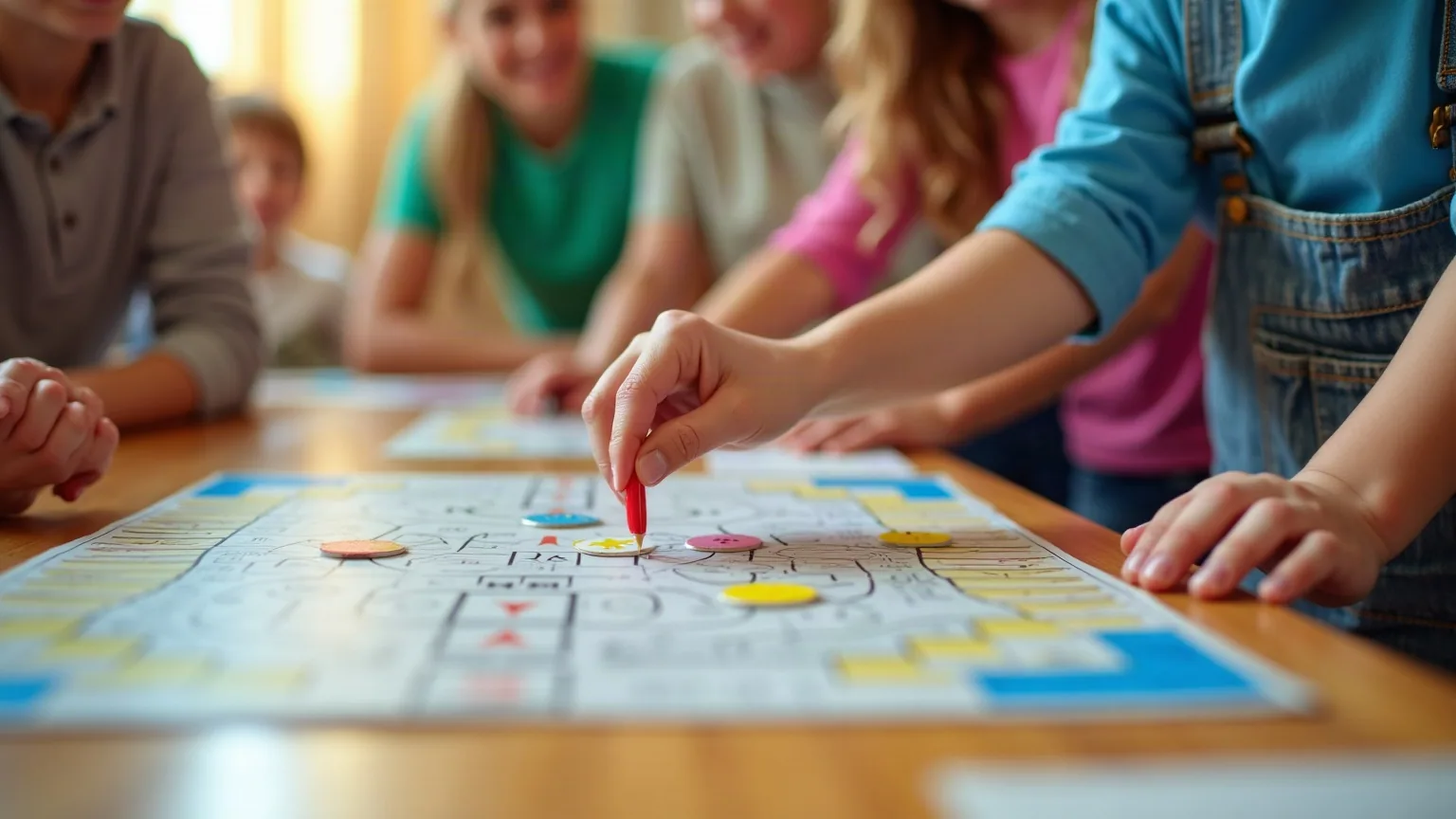
These six ideas work across different budgets and group sizes. Each includes practical equipment and realistic timings, not just a vague theme. Treat them as starting points: check in with the birthday child and adjust for your space, guests and any additional support needs.
Choose by number of guests, not by gender
| Idea | Practical guest count | Active time | Main location | Why choose it |
|---|---|---|---|---|
| Museum mystery at home | 6–12 | 45–60 min | Two rooms | Children like puzzles and teamwork |
| Build-a-bridge challenge | 6–12 | 40–50 min | Large table | Creative and hands-on group |
| Backyard team games | 8–16 | 50–60 min | Safe, enclosed garden | Energetic group with outdoor space |
| Pizza design workshop | 4–10 | 45–60 min | Kitchen/dining room | Guests enjoy making things together |
| Cinema-and-snack hangout | 3–8 | Film length plus food | Living room | Small, quieter gathering |
| Outing plus dessert | 4–8 | Booking-dependent | Bowling, skating or similar | Less work at home, higher likely cost |
The guest ranges are planning suggestions, not venue safety capacities. Count tables, supervision, exits, equipment and any guests who might need a quieter space before sending invitations. If the birthday child would genuinely prefer four close friends over the whole class, that's completely fine.
1. Museum mystery: an at-home investigation with three rounds
This is an original puzzle game you can assemble with paper, pens, six numbered envelopes and an ordinary box. The premise: an imaginary museum has mislaid an exhibit label. Three teams collect evidence to work out which display case it belongs to. Nobody needs to act as a suspect, and there is no need to hide clues in unsafe places.
Preparation, about 30 minutes: set up three stations at a table or across adjacent rooms. Station A has a number code; B has a matching puzzle; C has a simple ordering task. Each team gets an answer sheet and a pencil. For twelve children, divide them into three teams of four, letting the birthday child help balance the groups.
Station A — decode: write 3–1–11–5 with the note A=1, B=2, ... Z=26. The correct word is CAKE. That is simply a clue word, not a door code—nobody gets locked into or out of rooms.
Station B — match: place four drawn symbols—star, circle, triangle, square—beside four shuffled descriptions. One description says “the shape with exactly three sides”; the matching answer is triangle. You can adjust the difficulty by providing several clues rather than one obvious answer.
Station C — order: give children four paper event cards, labelled “Mix batter”, “Fill tin”, “Bake”, and “Cool”. Their job is to put them in a logical sequence: mix → fill → bake → cool. No children operate a real oven as part of the game.
Each team's finished answer sheet points to a sealed final envelope marked CAKE / TRIANGLE / MIX. Inside is a short congratulatory note or directions to the prize table. Use non-food prizes like bookmarks or badges if allergies are uncertain. Have an adult drop hints after a few minutes so no group gets stuck while others finish.
Run it: allow 10 minutes for a story briefing, 3 × 10-minute rounds, 10 minutes for checking answers and a 5-minute finish. Nobody gets eliminated; everyone joins in the final reveal. Prepare the puzzle in advance and solve it yourself once before the party to check the clues.
2. Build-a-bridge challenge: competition without complicated supplies
Give each team 20 sheets of ordinary paper, a short length of masking tape, two books placed 25 cm apart and six identical coins or washers. The challenge is to build a bridge across the gap that holds as many test weights as possible. A responsible adult should manage the weights so small pieces aren't dropped where younger siblings might find them.
Suggested rules: give teams 15 minutes to design; after 10 minutes of testing and improvements, an adult adds weights gently, one at a time, to the centre of each bridge. Record the number held for five seconds. If bridges tie, award a bonus point for using fewer sheets. Hand out light-hearted prizes alongside technical ones: “best design story” or “most surprising fix”.
Offer a low-pressure alternative: children who prefer drawing can sketch a team logo or name for their bridge. The task works well indoors, is quick to clear up and doesn't require messy experiments or expensive craft supplies.
Host mistake to avoid: making the goal purely about winning. At ten, the drama of a funny collapse and a quick redesign is often far more entertaining than crowning a single champion for twenty minutes.
3. Backyard team challenge: four short rounds
This format needs a reasonably flat garden or outdoor area and an indoor backup for rain. Mark out a clear play zone well away from parked cars, ponds and cooking equipment. Check with parents about any access or mobility needs beforehand.
Run four stations, roughly 10 minutes each: target toss (soft beanbags into numbered buckets); memory relay (study twelve objects for thirty seconds, then write down what you remember at a table); balloon-free keep-up (keep a large lightweight foam ball moving through the team without using hands); and giant drawing (the team draws an animal together on large paper without speaking). The last two are cooperative, so less athletic children aren't sidelined.
Use a straightforward rotation: teams move to the next station on a whistle or verbal cue, collecting stars for teamwork and effort rather than just speed. One adult should be able to see the entire play area; bring in extra helpers depending on your group size and garden layout.
Rain plan: swap the target toss for paper balls aimed at laundry baskets, keep the memory table indoors, and move the drawing challenge to a table. Never assume a wet lawn is safe for timed running games.
4. Pizza design workshop: a meal and an activity in one
Give guests individual bases or pre-baked flatbreads, small bowls of prepared toppings and named baking trays. Each child creates a topping pattern or custom design. A responsible adult must handle the oven, food temperatures and any sharp tools; keep children from crowding around the hot door.
Suggested 60-minute flow: 10 minutes for handwashing and choosing toppings, 15 minutes to assemble, 15–20 minutes for adult-managed cooking, then 15 minutes to eat and compare creations. If any child needs an allergy-safe version, set aside separate ingredients and clean utensils before starting. Watch for cross-contact rather than assuming a “vegetarian” option covers all dietary needs.
While the food cooks, invite guests to invent a menu name and short description for their pizza. The cooking doubles as entertainment, which saves planning extra party games. Use the pizza quantity calculator to estimate bases and slices, adjusting for appetites and other snacks.
5. Cinema-and-snack hangout: a quieter birthday
For four or five close friends, a film afternoon can be ideal. Let the birthday child pick from two suitable options, and provide enough comfortable chairs, floor cushions or sofas so nobody is stuck on a cold floor. Check the running time and age rating in advance—families often have different rules about what their children may watch.
Set up an easy arrival activity: guests make paper cinema tickets, write down a one-sentence plot prediction, and choose their seats. Pause midway only if the film is long and the group gets restless. Serve a filling snack or simple meal before or afterwards, rather than relying on an endless bowl of sweets.
Accessibility detail: leave space for anyone who needs to sit further from loud speakers or wants to step out briefly. A quiet adjoining room is handy if someone gets overwhelmed. This is a relaxed hangout, not a test of who can sit silently the longest.
6. Activity outing plus dessert: check the booking details first
Bowling, skating, a kid-friendly escape room or a craft studio can work brilliantly for small groups. Pricing varies widely by area and provider, so get a firm quote rather than relying on generic per-child estimates online.
Before paying a deposit, check what is included: activity length, group size limits, age and height rules, staff supervision, food, gear hire, cancellation terms, and whether parents must sign waivers. Factor in transport too—an hour's drive each way for a ninety-minute party might be too much for some families.
For a lower-cost option, book standard admission for a few children and head home afterwards for cake. You don't have to buy a full venue package just because they offer one.
A two-hour home-party schedule for ten-year-olds
| Time after start | What happens | Host's job |
|---|---|---|
| 0–15 min | Arrive, put bags away, easy table activity | Confirm arrivals and parent contact details |
| 15–25 min | Explain main game and form groups | Give clear rules and accessible roles |
| 25–70 min | Run headline activity | Help stalled teams; keep instructions moving |
| 70–95 min | Food and drinks | Check allergies and supervise as needed |
| 95–105 min | Cake and group photo, if wanted | Allow anyone to opt out of photos |
| 105–115 min | Quick final challenge or free chat | Set up collection area |
| 115–120 min | Collect bags, goodbye | Hand children to agreed adults |
If your headline activity involves cooking, schedule it ahead of the food break so the children eat what they make. If you are showing a feature-length film, extend the party or skip extra games; fitting a full movie into a schedule packed with other activities leaves no breathing room.
Worked example budget: ten children at home
These are illustrative planning allowances in pounds, not current vendor or supermarket prices. For this scenario, suppose ten children are attending with an overall budget cap of £180.
| Category | Allowance |
|---|---|
| Food and drinks | £65 |
| Cake or ingredients | £25 |
| Main activity materials | £25 |
| Paper, table supplies and simple decoration | £15 |
| Small take-home item, optional | £20 |
| Contingency | £30 |
| Total | £180 |
The example works out to £18 per invited child, but siblings, extra supplies, or venue fees will shift that total. You can drop optional favours to save £20 or borrow equipment to reduce activity costs. Put your real numbers into the party budget calculator before buying anything.
Food and guest arrangements that make the party run smoothly
Ask parents or carers for emergency contact details and allergy updates before the party, and confirm who is authorised to collect each child. A proper checklist with pickup arrangements is far more useful on the day than a rough head count; use the guest list planner to stay organised.
For a straightforward menu, serve pizza or filled rolls, sliced fruit and vegetables, water and cake. Keep safe, clearly separated alternatives ready for guests with known dietary requirements. The FARE guide for communicating with caregivers about food allergies explains why ingredient clarity matters. Don't label food “allergy-free” without checking every single packet.
Give parents the exact start and finish times, the main activity, footwear requirements and an on-the-day phone number. Mention if parts of the day are outdoors or require travel. For phrasing examples, look at the party invitation wording guide and use the invitation wording builder to pull together your details.
How to avoid the three common planning traps
Too many activities. One forty-five-minute main activity plus food and a small fallback is plenty for a home party. Six games, a craft and an outing crammed into two hours leave children rushed and adults exhausted.
An activity that excludes part of the group. If a game requires standing, running, fast reading or speaking in front of everyone, provide a way to contribute from a table, with a partner, or in a supporting role. A birthday shouldn't feel like an assessment.
An unclear finish. Children take time to find shoes, coats and party bags. Position an adult near the door for handovers, and avoid launching a high-energy game five minutes before collection time.
Questions parents ask about tenth birthdays
How many guests should we invite?
There is no magic formula for tenth birthdays. Choose a guest count that matches your child's friendships, your budget, and available space. Six to ten guests is usually manageable at home, but an outing with three or four close friends can be just as memorable.
Do we still need party bags?
No. If you want to give something, one useful item linked to the day is plenty: a craft they made, an inexpensive notebook or their completed puzzle sheet. Let the birthday child decide whether party bags matter or if they'd rather use that budget elsewhere.
Should the birthday child choose the whole plan?
Offer a genuine choice between two or three workable plans. Let them choose the activity and guest list within those boundaries, while you remain responsible for safety, supervision, invitations and the overall budget.
What if a friend doesn't like competitive games?
Stick to team or cooperative games, give children alternative roles like scorekeeper or designer, and avoid public elimination rounds. Plenty of ten-year-olds would rather chat and make something than race against a stopwatch.
The strongest tenth-birthday idea is one guests can actually enjoy together. Choose one solid activity, build a realistic schedule around it, and keep things relaxed enough that the birthday child—and you—can actually enjoy it.