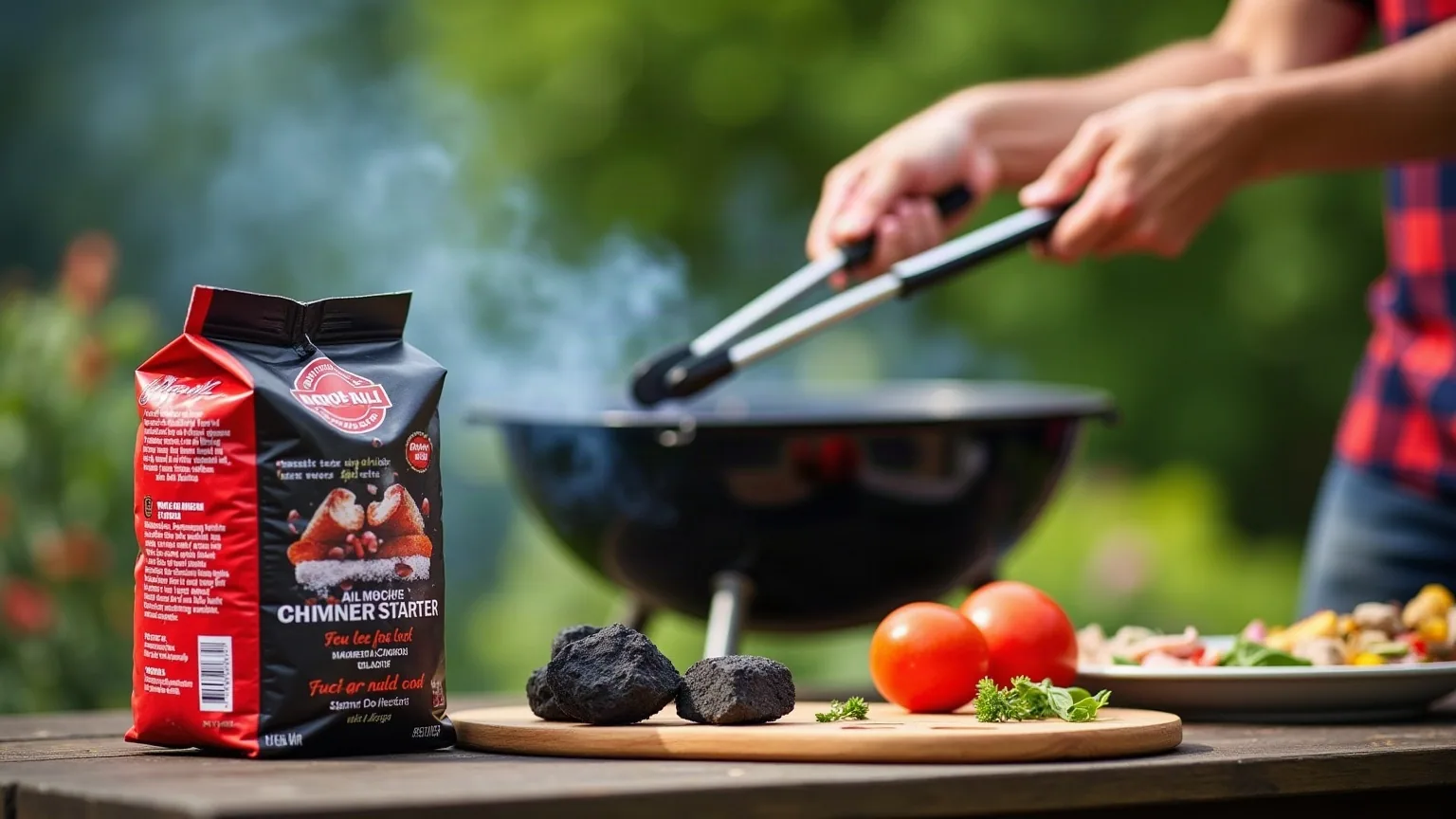
The most sensible way to plan is to measure your own chimney starter with unlit fuel once, choose the right direct or indirect setup, and estimate how many starts or top-ups your menu will actually need. The figures below are working examples rather than fixed guarantees of burn time or cooking temperature.
Quick answer: use a chimney as the measuring unit
Weber's charcoal-temperature guide suggests one-third of a chimney for low-temperature/shorter indirect cooking, half a chimney for medium indirect cooking, and a full chimney for higher-temperature direct cooking as practical starting points. The guide also notes that grill size, weather, and the length of the cook will naturally shift those amounts.
Kingsford's fuel-arrangement guide uses its own standard chimney holding approximately 4 lb (about 1.8 kg) of its briquettes. It makes a helpful benchmark, but it is not proof that every charcoal chimney holds 1.8 kg, or that lump charcoal and briquettes share the same density.
For a standard home barbecue, start with the maker's guidelines and a measured fraction of a chimney. Tipping a whole bag at random into a modest grill is a quick way to waste fuel and overheat the food.
| Cooking task | Starting approach | Why |
|---|---|---|
| Brief direct-heat cook | About ½ to one chimney, depending on grill and food | Enough concentrated hot coals for the required area |
| Two-zone cooking | About ½–one chimney, banked to one side | Direct heat and a cooler indirect area |
| Short indirect cook | Approximately ⅓–½ chimney as a manufacturer-style starting point | Moderate, controlled fire; lid required |
| Several grilling waves | Start as above, plan separate measured top-ups | Avoid lighting all fuel at once and wasting it |
| Long slow cook | Follow the smoker/grill's specific fuel arrangement | A snake or charcoal basket may require significant unlit fuel and long-term monitoring |
Treat any guide as a starting method, not a replacement for your manual. A tabletop BBQ, an open masonry pit, a kettle, and an enclosed smoker behave very differently. If the manufacturer specifies a maximum fill or a recommended coal bed, stick to that.
Find your chimney's actual capacity in five minutes
All you need is your unlit fuel, the chimney starter, and a kitchen scale. Do this before lighting anything, outdoors or in a clear prep area, and never try weighing hot coals.
- Set an empty container on the scale and zero it.
- Fill the chimney with unlit fuel to the line or level you would normally use. Pour that fuel into the container to weigh it.
- Write the full-chimney weight on a label, and note whether it was briquettes or lump charcoal.
- Calculate ½ and ⅓ of that weight; use these as repeatable starting portions.
- Repeat if you change fuel types or chimney size. Lightweight lump charcoal can occupy more space for a given weight than briquettes.
Worked example (illustrative capacity, not a product specification): Assume your full chimney holds 2.0 kg of the particular briquettes you use. Then:
| Chimney fraction | Calculated cold fuel weight |
|---|---|
| One-third | 0.67 kg (2.0 ÷ 3, rounded) |
| One-half | 1.00 kg |
| Three-quarters | 1.50 kg |
| Full | 2.00 kg |
With that number in hand, buying the right bag size becomes straightforward. If your chimney holds 1.5 kg instead, scale everything down to match. Assuming that half a chimney is always exactly one kilo will lead you astray on plenty of setups.
Example: a quick BBQ for 10 guests
Menu: burgers or veggie burgers, grilled vegetables, and prepared sides, cooked on a single covered medium kettle. Grilling in two waves keeps things manageable so nobody is juggling ten different orders at the same time.
Plan: Start with a sensible direct or two-zone load, perhaps half to three-quarters of your measured chimney if that aligns with your grill's manual. Keep extra unlit fuel nearby, but don't assume you will need another full chimney. Set aside a cooler indirect zone for anything that needs extra time, and rely on a food thermometer rather than guessing doneness by colour.
If your chimney holds 2 kg: A three-quarter start comes to 1.5 kg. Having a further half-chimney in reserve adds 1.0 kg. That makes 2.5 kg on hand for this particular plan, though you won't necessarily burn it all. Buying a bag that covers that amount with a modest buffer should see you through. Just check the pack size against your manual.
Important: Headcount alone does not dictate how many batches you will need to cook. Usable grate space, the thickness of the food, and how much room you leave for indirect cooking settle that.
Example: feeding 20 guests in three waves
Suppose a 57 cm covered kettle comfortably fits around seven modest portions per batch once you have tested the layout (remember that seven per wave is a made-up scenario for this calculation). To turn out twenty portions, you need:
20 portions ÷ 7 per wave = 2.86 waves → plan 3 waves.
If you need to keep heat steady across all three waves, a workable plan might look like:
| Fuel step | Chimney fraction | With a measured 2 kg full chimney |
|---|---|---|
| Initial start | 1 full | 2.0 kg |
| First reserve/top-up allowance | ½ | 1.0 kg |
| Second reserve/top-up allowance | ½ | 1.0 kg |
| Maximum budgeted fuel | 2 full-chimney equivalents | 4.0 kg |
Treat this as a conservative shopping scenario, not an order to dump two extra chimneyfuls onto an active fire. With fast-cooking batches, a tight lid, and careful vent management, you might not touch the reserves at all. On a windy day, with damp fuel, or across a longer session, things shift. Only add fuel when the temperature and cooking plan call for it, as directed by the appliance manual. And remember: piling on extra charcoal will never make up for running out of grate space.
If you want some peace of mind, a 5 kg bag covers the calculated 4 kg and leaves a 1 kg unlit reserve. That maths only holds up, though, if your chimney starter genuinely holds 2 kg. Bag weight alone tells you nothing about how long the fire will burn.
Direct versus indirect heat changes the charcoal plan
Direct heat sits food straight over glowing coals. It is ideal for burgers, sausages, sliced veg, and anything needing a quick sear. You need a hotter bed of coals, but cooking time stays relatively short.
Indirect heat pushes the fuel to the side, keeping the food off the direct flame. With the lid down, convective heat circulates evenly—perfect for thicker cuts or items that need gentle cooking. Weber's guides on direct, indirect and 50/50 methods illustrate the physical layouts well.
A two-zone arrangement works brilliantly when catering for a mixed crowd: sear over the coals, shift pieces over to the indirect side as needed, and check temperatures as you go. Avoid scattering a small amount of charcoal evenly across the whole bottom grate; banking it into a concentrated zone gives far better heat control.
Long slow smoking operates on entirely different principles. Charcoal snakes, baskets, and Minion-style arrangements rely on unlit fuel catching gradually. Burn time hinges on ambient wind, target cooker temperature, insulation, charcoal type, and airflow. Stick to a proven method for your specific smoker and run a trial cook before hosting a crowd; a quick-grilling estimate is no guide for a twelve-hour smoke.
Lump charcoal or briquettes: what changes?
Briquettes are uniform in size, making them easy to measure and repeat. Lump charcoal varies widely from small pieces to large chunks, which changes how tightly it packs, how air flows through it, and how fast it burns. Neither fuel is an all-round miracle worker; each behaves differently.
The best fuel is simply the one you know how to measure, light, and manage in your own barbecue. Avoid breaking open an unfamiliar bulk brand for a big gathering without testing it first, and always check the packaging for additives or manufacturer warnings.
Don't compare only kilograms across different products. A manufacturer's chimney fraction is almost always more reliable than generic online advice claiming every barbecue needs exactly two kilos.
Lighting and top-ups without ruining the cooking schedule
A chimney starter takes the guesswork out of lighting. Kingsford's chimney guide suggests placing suitable firelighters beneath the base, lighting up, and waiting until the briquettes ash over before carefully tipping them into the barbecue. Follow the starter manufacturer and fuel instructions closely, especially regarding safe fill heights and handling.
For party scheduling:
- Before guests arrive: Prepare the cooking area outdoors away from structures, guests and play spaces. Put on suitable heat-resistant gloves and keep long tongs accessible.
- Allow lighting time: Reserve time for the fuel to ignite and for the grill to stabilise, not just the food's cook time. Kingsford suggests roughly 15–20 minutes in its own example, but real conditions vary.
- Cook by food group: Grill similar items together so one batch isn't repeatedly moved around while another waits raw.
- Monitor actual heat: Use lid, vents and thermometer as appropriate. Add lit charcoal prepared safely in a separate starter, only when needed.
- Don't use lighter fluid on hot coals: It can flash dangerously. Never use petrol or other improvised fuel.
Guest-count tip: If feeding twenty guests means running five separate batches within a tight two-hour window, tweaking the food or borrowing a second grill with an extra pair of hands will help far more than buying a bigger sack of charcoal.
Safety: never bring charcoal indoors, even after cooking
Lit or smouldering charcoal produces carbon monoxide, a colourless, odourless gas that can kill without warning. The NHS explicitly warns never to use barbecues indoors or inside tents. Fire-service guidance notes that fumes linger for hours and that cracking open a window or tent flap offers no real protection. Never light or bring a grill into a garage, enclosed porch, tent, caravan, or beneath a low awning.
Set the barbecue on a firm, level, fire-safe surface well away from wooden fences, outbuildings, children, and pets. Never walk away and leave it unattended. Keep water, sand, or an extinguisher close at hand, follow the manual to choke off the air when finished, and let the ash go stone cold before throwing it out. Never dump warm ash into a plastic dustbin.
On the food side, remember that fuel quantity does not replace safe cooking practices. Keep raw and cooked items strictly separate with dedicated tongs and platters, probe chicken and burgers with a digital thermometer, and keep hot food out of the danger zone. Our BBQ party checklist covers timing and layout, while the meat-per-person guide helps nail down raw buying weights.
Buying checklist you can actually use
Before you buy a charcoal bag, write down:
- Your grill model and size, and the manufacturer's allowed fuel arrangement.
- Your fuel type and measured weight of a full cold chimney.
- Direct, indirect or mixed cooking for each main food item.
- The number of realistic batches at your cooking surface capacity.
- Initial fuel and reserve using your measured fractions, not an anonymous online conversion.
- Whether you have a safe place to light top-up fuel and an experienced person to manage the grill.
- A backup menu for rain or a grill problem; never move the charcoal grill indoors to salvage the event.
For the 20-person worked example above, the cold-fuel plan is 2 + 1 + 1 = 4 kg maximum allowance, with a one-kilo shopping buffer if buying a 5 kg bag. If only the initial 2 kg is needed, keep the remainder dry and unlit for a future cook.
Frequently asked questions
How much charcoal is needed for 20 people?
You cannot calculate that from 20 guests alone. Our worked example uses a measured 2 kg full chimney, an initial full chimney and two optional half-chimney reserves, totalling up to 4 kg. A different grill, food and cooking duration can change it considerably.
How much charcoal should I put in a small BBQ?
Follow its instructions and use only the fuel needed for the cooking area. Do not apply large-kettle chimney amounts to a small disposable or portable grill. UK fire-safety guidance advises against overfilling a conventional BBQ with coals.
How long does a bag of charcoal last?
There is no single answer without factoring in the grill design, how much you light at once, vent settings, outdoor temperature, and fuel type. Run a standard cook on your own kit first so you know what to expect on the day.
Can I move a charcoal BBQ into a shed if it rains?
No. Charcoal—whether blazing, smouldering, or cooling down—must stay outdoors and well clear of enclosed spaces due to the risk of fatal carbon monoxide poisoning. If the weather turns, pause the session or move the food inside to a standard kitchen cooker.
Related reading: BBQ party checklist · BBQ meat amounts · Garden party weather planning · Party food quantities.